Monday, 10 April 2017

Trend Development - Sustainability in Economic, Social and Environmental Development

What is Sustainability?

Sustainability is the study of how natural systems function, remain diverse and produce everything it needs for the ecology to remain in balance (Environmentalscience.org). Therefore, the human civilization need to take resources which could sustain our modern life. Sustainability takes into account how we might live in harmony with the natural world around us, protecting it from damage and destruction. 

In 2005, according to World Summit on Social Development there are 3 big factors which contribute to the development of sustainability, such as:
  1. Economic
    Sustainability in economic development is very important in order to keep the environment safe for the future. Economic development is about giving people what they want without compromising quality of life, especially in the developing world, and reducing the financial burden and “red tape” of doing the right thing. The relation between sustainability and economic development is called as "sustainable economic growth". Sustainable economic growth is economic development that attempts to satisfy the needs of humans but in a manner that sustains natural resources and the environment for future generations.

  2. Social
    "A process for creating sustainable, successful places that promote wellbeing, by understanding what people need from the places they live and work. Social sustainability combines design of the physical realm with design of the social world – infrastructure to support social and cultural life, social amenities, systems for citizen engagement and space for people and places to evolve", by Social Life

  3. Environment
    Environment often get attention when it comes on sustainability. Due to the pressures of over consumption, population and technology, the biophysical environment is being degraded, sometimes permanently. 
    Environmental protection is a practice of protecting the natural environment on individual, organisation controlled or governmental levels, for the benefit of both the environment and humans. 

By understanding how sustainability work in economic, social, and environment, we could get more knowledge and this knowledge can be applied to the fashion industry in term of creating brand, producing, and anything which relates to designing process.


Reference:

  1. https://en.wikipedia.org/wiki/Environmental_protection
  2. https://en.wikipedia.org/wiki/Sustainable_development
  3. http://study.com/academy/lesson/what-is-sustainable-economic-growth-definition-lesson-quiz.html#lesson
  4. https://sustainabledevelopment.un.org/topics/greeneconomy


Trend Development - Millennial Moving Toward Minimalism

In order to know whether millennial are seeking towards minimalist lifestyle, I did some research on millennial lifestyle in term of technology & mobility, their living lifestyle or living preferences, experiences and their possessions, and how they react on unemployment/ debt/ student loan.


(N.B: These are the PPT that I did in power point. I screen shot and put it here and add some description)


References:

  1. http://www.becomingminimalist.com/millennials/
  2. www.belltreeforums.com › Forum Home › General Discussion › Brewster's Cafe
  3. http://www.millennialmarketing.com/2010/05/millennials-becoming-minimalists/
  4. elitedaily.com/life/culture/millennials-minimalists/1256085/

Trend Development - Minimalist Lifestyle

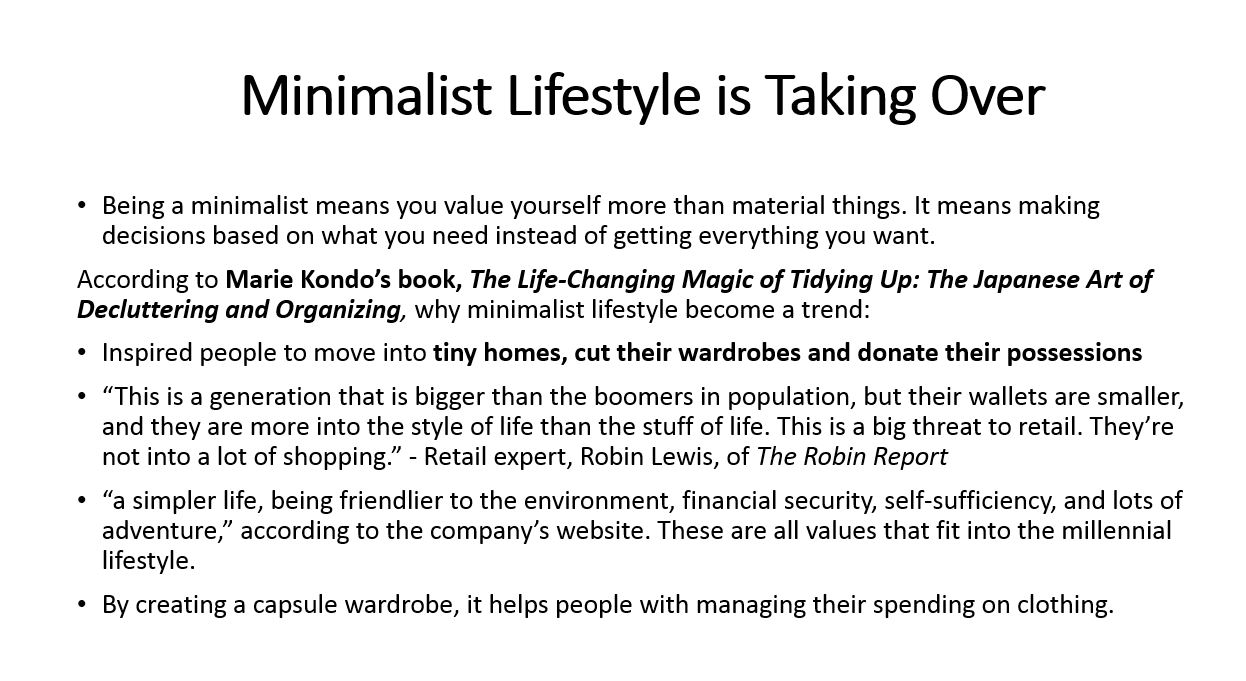
Basically, minimalist lifestyle means that we live in the simple environment which enough to fulfill our needs. According to Marie Kondo's book, through minimalist lifestyle, people start to life in the simpler environment, become more manageable in term of their spending. Living in minimalist lifestyle doesn't mean that people must throw away lots of things, instead, keep things which is suitable to our taste such as color preferences, favorable details and details, and others. In term of fashion, minimalist lifestyle can be achieved by creating a capsule wardrobe. By creating a capsule wardrobe, it help us to manage our spending and help us to realized on whats our fashion preference in term of details, colors, fabrics, functionality, silhouette, and others.

Living in a minimalist lifestyle of course could bring advantages to ourselves. 

  1. Decluttering helps people breathe
    Living a minimalist lifestyle we start to get rid of unrelated/unused stuffs and only keep useful and favorable things. This will give more room and space
  2. Minimalism allows for refocusing
    When we have lots of things, its hard for us to focus on one thing and our concentrations are all over the place. Through this lifestyle, we could focus in one thing and work on it.
  3. Less stuff equals more money
    As we get rid of luxurious stuff at home, we save money and we can use it for more important things such as, pay debt or student loan.
  4. Save more time and energy
    Having less stuff at home or our surroundings make us focus on thing we need and use the extra time to enjoy what we like. Besides saving time, the energy used to dealing with other stuff will be available for other activities. As a result, people with less material lifestyle will be healthier and stronger 


(N.B: These are the PPT that I did in power point. I screen shot and put it here and add some description)


References:

  1. https://nosidebar.com/why-minimalism/
  2. time.com/3738202/minimalism-clutter-too-much-stuff/
  3. www.theminimalists.com/radical/
  4. https://www.forbes.com/forbes/welcome/?toURL=https://www.forbes.com/sites/deborahweinswig/2016/09/07/millennials-go-minimal-the-decluttering-lifestyle-trend-that-is-taking-over/&refURL

Sunday, 9 April 2017

Trend Development - Millennial Lifestyle

As millennial generations were born in 1980-2000, they are group of people which exposed more to the digital world either for receiving information or communication. Through internet and smartphones millennial become tech-savvy until to the end extend that only few of them still refer back to newspaper to get information. Through some research, here are evidence on how millennial have been fully affected into the digital world compared to the other generations (gen x & boomer).


Moreover, millennial are encumbered with student loan and have less money to spend because they have less income. Due to debt/loan, millennial need more income in order to support their daily lifestyle. However, millennial are having difficulty in getting a job because they are entering the struggling job market, therefore, lots of millennial are seeking for the unpaid internship in order to get experience. Besides having difficulties in income and job, compared to the older generations, millennial tend to postpone marriage and home ownership. Research depicted that in 1970s, the median age for marriage was 23 years old, while in 2010s it increased to 30 years old. This shows that millennial are focusing more into the quality of life rather than items/stuffs for life.


In term of ownership, millennial are not willing to buy or own something. For instance, car. Millennial are prefer to use the new service which provide access to the product without ownership. Therefore, the new term was created which was called as "sharing economy" which could describe how millennial lifestyle in term of ownership. On the other hand, millennial are moving to the healthier lifestyle which they think working out is a very important thing. They used the help of digital and online world to find out what and how they could full fill a healthier life. Due to this healthier life, millennial are willing to spend more money on compelling brands through online shopping and they are more focusing on the quality of the things instead of how much they sell the things (quality>price).


(N.B: These are the PPT that I did in power point. I screen shot and put it here and add some description)


Reference:
  1. http://www.goldmansachs.com/our-thinking/pages/millennials/
  2. https://www.visioncritical.com/millennial-infographics/
  3. www.huffingtonpost.com/news/millennial-lifestyle/
  4. https://millennialsofsg.com/category/millennial-lifestyle/
  5. www.straitstimes.com/lifestyle/millennials-in-charge-of-millennials

Trend Development - BIOMIMICRY

Definition of Biomimicry 

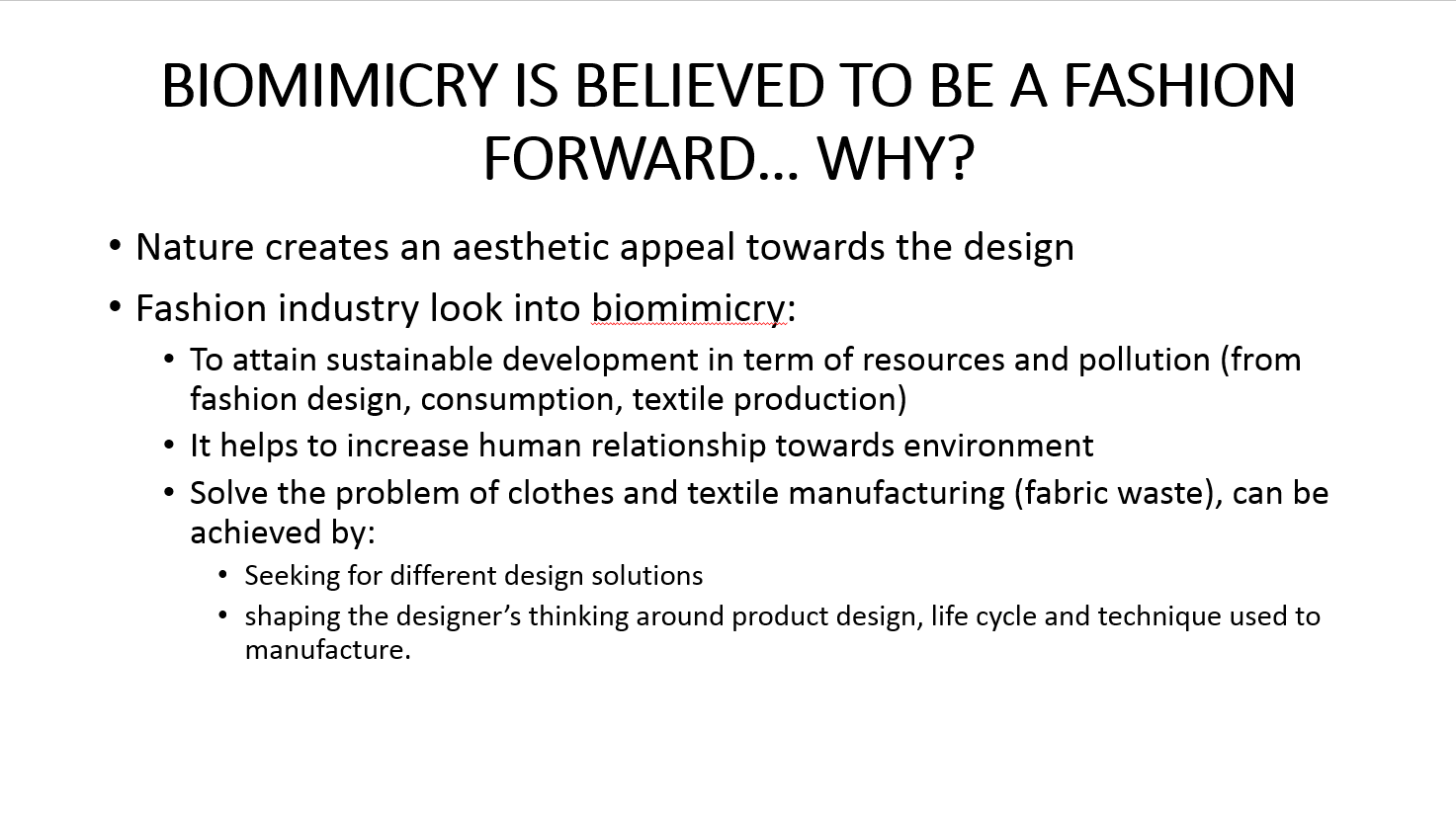
The term "biomimicry" or can be called as "biomimetics" is basically refer to any innovations/designs which inspired or imitated nature’s lifecycle, time-tested patterns, and strategies. This term was created in response to shift away or bring down the technology trend which has been popularized nowadays among the young generations. By observing the definition of biomimicry itself, there are some key words when it comes to biomimicry/biomimetics such as, life and imitation.
Through some research, it depicts that nature could bring and create an aesthetic appeal to any designs. On the other hand, sustainability has been a hot topic in the fashion industry. Therefore, lots of fashion industries are looking or seeking into biomimicry  to succeed in achieving sustainable development in the face of resource depletion and increasing pollution resulting from fashion design, consumption and textile production. Besides, it also indirectly increase the relationship between human and their environment because biomimicry help human to understand more in-depth about nature and be open-minded on how they interpret nature. Biomimicry/ biomimetic also helps fashion industries to manage and handle their fabric waste from the production team and lead designers to think more creatively on different solutions.
After understanding what is the definition of biomimicry, Here are some examples of designs which was inspired from nature.
  1. Velcro
    Invented by George de Mestral, a Swiss engineer in 1941. He got the inspiration when he removed burrs from his dog and take a closer look on how the burrs look like. As a result, the tiny hooks on the surface of burr has inspired George to design velcro
  2. "Morphotex" Dress
    Morphotex is a fabric with 60% polyester and 40% nylon invented by Teijin in Japan. This fabric was created and inspired from Morpho butterfly wings. The colour achieved was not from any fabric dye or paints, instead it came with the helps of light reflection and refraction; and interference.
  1.  Waterproof fabric
    Nowadays there are lots of source which new inventors were referring to create a better quality of waterproof fabric. The quality of waterproof was measured on how long the materials will take in order to break the droplet. the faster it takes, the better the quality is. Some new invented waterproof materials were inspired from either lotus leaves or butterfly wings.
  2. Watercube design in Beijing Olympics
    The watercube interior design of Beijing Olympics was inspired from the structure of soap bubbles, and it gives a natural feel as well as earthquake resistance. Even though this is not the best example of biomimicry in the purest sense, but the nature element can be seen from the design.
Some example of biomimicry in fashion:
  1. "Miura Ori" scarf
    Invented by Diana Eng with fabric combination 80% wool and 20% cashmere. Miura Ori itself means "leaf fold" in Japanese and was created by imitating the hornbeam leaf.
  2. 3D printed hollow heel
    Invented by Marieka Ratsma (Fashion Designer) & Kostika Spaho (American Architect). This 3D printed heel was inspired from a bird's skull. The heel platform was inspired from a bird's cranium and the tapered beak for the spike of the heel.
From all the examples of biomimicry in fashion, I feel like it looks quite minimalist, therefore, I am planning on searching millennial lifestyle and how minimalist lifestyle have been adapted to young generations.


(N.B: These are the PPT that I did in power point. I screen shot and put it here and add some description)


References:
  1. https://en.wikipedia.org/wiki/Biomimetics
  2. http://www.ecouterre.com/10-eco-fashion-garments-inspired-by-nature-and-biomimicry/2/
  3. https://germinature.com/2016/05/23/biomimicry-is-fashion-forward/
  4. http://inhabitat.com/finding-design-inspiration-in-nature-biomimicry-for-a-better-planet/
  5. https://biomimicry.org/what-is-biomimicry/
  6. http://www.treehugger.com/corporate-responsibility/water-lily-inspires-waterproofing.html
  7. http://www.hongkiat.com/blog/nature-inspired-tech/
  8. https://www.dezeen.com/2012/07/17/biomimicry-shoe-by-marieka-ratsma-and-kostika-spaho/

Sunday, 26 February 2017

Trend Development - Advantages of Nature

Advantages of Nature as Both Inspiration and Working/Designing Area 

As time pass by, nature is no longer be the first place for us to get an inspiration, instead, advanced technologies had replaced everything and gave big impacts to the next generations. Besides no longer as a resource, we also started our lifestyle by doing everything efficiently, which means we only refer to internet resources instead of going outdoor and find for good inspirations. As a result, there are less innovations which derived or took inspiration directly from nature which cause loosing connection to nature. Therefore, does it means sustainability is at risk?

Definition of Sustainability:
  1. The ability to be maintained at a certain rate or level.
  2. Development that meets the needs of the present without compromising the ability of future generations to meet their own needs.
Why is it important to have a connection with nature?


According to Edward O. Wilson, who introduced and popularized the biophilia hypothesis, conclude that all human beings and other living systems have an instinctive bond which were created from the time we born and continuously nurtured as we grow. Through this hypothesis, it shows that children are better able to concentrate after contact with nature (Taylor et al. 2001) and that exposure to natural environments improves children’s cognitive development by improving their awareness, reasoning and observational skills (Pyle 2002).

By observing the result, we could see that there is a positive impact given by nature/ environment to children/human observation skills. In this case, improving human observation skills can be relate to human creative thinking process. According to Juliet Zhu, Professor of Marketing at CKGSB, explained how environmental factors such as color, lighting, and noise could affect our creative thinking process and productivity. 

  1. Color (Blue vs Red)
    In the experiments, Juliet Zhu used red vs blue as the chosen color because some people were arguing that red tend to increase creativity and vise versa. Therefore, the result shows that blue helps people with increasing their creativity especially in designing because blue color is more likely to be an approach mindset, which make people to be more open-minded and risk taking. While red make people think of blood, emergency, stop signs, ambulance, which make people be more careful and vigilant in designing.

  2. Lighting (Bright vs Dim)
    In the results, it shows that people who work in the dim/dark room are more likely to decipher images compared to those in the bright room because they are more open to new things.
  3. Noise/sound
    Through the experiments, it shows that moderate sound lead people to think out of the box because the sound temporarily make us move from our task and we start to 'mind-wander', for instance, "Oh, what did I have for lunch? Can my lunch inspired me or solve this task?". Instead of being too focus into our task which make us narrow-minded and can't think out of the box, it's better to relax ourselves and think another things which might be a new inspiration. (mind-wander: task-unrelated thought)
From all these researches and experiments, we could see how nature/environment could affect human creativity in designing by only using simple factors which we could see and meet in our daily life. In a nutshell, working outdoor could boost our creativity. 

The Advantages of Using Nature as an Inspiration

A design discipline which look into nature as an inspiration is called as "biomimicry"

  1. Nourish Curiosity 
    Give us opportunity to learn about life's water, energy, and material-use strategies
  2. Give Permission to Play
    Based on some experiments, working outdoor in designing process boost creativity level
  3. Disrupt Traditional Thinking 
    Starting by asking, "How nature would solve this challenge?", make us (designing team) to explore new solutions and brainstorm opportunities to solve challenges in new and innovative ways.
  4.  Accomplish multiple objectives with a single gesture
    Nature has no one single-purpose tools, for instance, a tree. Tree provide shade/shelter through their leaves, generating water, and bark to transfer/protect water beneath the surface. Therefore, looking for inspiration from nature could lead us to create a multi-functional designs.

  5. Adapt to context and climate
    Creating new design which could adapt to climate changes. This type of design actually has been created by the help of advance technology, but through nature, designers are trained to be more creative in order to reach that point with Eco-friendly materials and minimize additional cost.

Some example of designs inspired from nature:
A Wearable Planter
Designed by Colleen Jordan 

Picnyc Table 
Designed by Haiko Cornelissen Architecten (made of real grass)

"Suddenly spilling water becomes a necessity instead of a problem" 
- Haiko Cornelissen Architecten 


Dilston Grove
Designed by Ackroyd & Harvey


Living Wall
Designed by Jean Nouvel 


Leave T-shirt
Designed by Dave Rittinger

Interactive Cloud Lamp 
Designed by Richard Clarkson

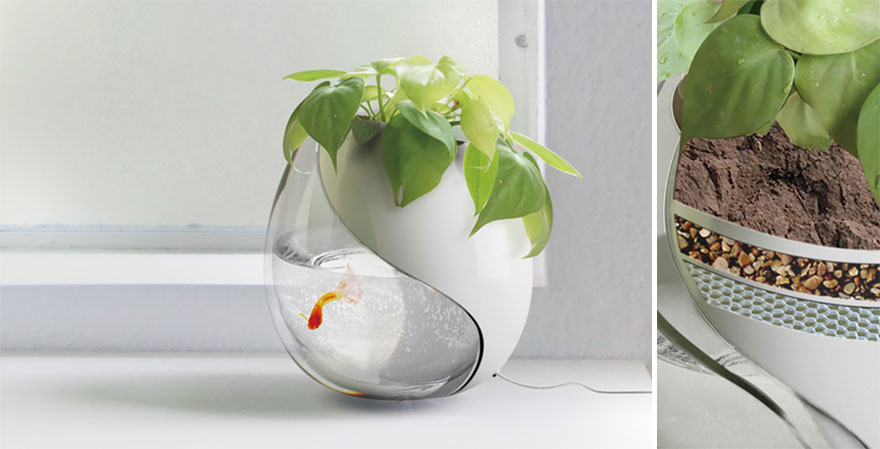
One Pot, Two Lives
Designed by Sheng Zhe Feng & Ling Yuan Chou


Waterdrop Magnets
Designed by Appree


References:
  1. http://www.triplepundit.com/2010/11/losing-our-connection-to-nature-is-sustainability-at-risk/
  2. https://en.wikipedia.org/wiki/Mind-wandering
  3. http://knowledge.ckgsb.edu.cn/2014/01/13/management/how-the-environment-impacts-creative-thinking/
  4. https://www.greenbiz.com/article/9-benefits-blending-biomimicry-and-built-environment
  5. http://www.boredpanda.com/nature-green-design-ideas/
  6. http://static.boredpanda.com/blog/wp-content/uploads/2014/07/green-design-ideas-inspired-by-nature-2-4-1.jpg
  7. http://static.boredpanda.com/blog/wp-content/uploads/2014/07/green-design-ideas-inspired-by-nature-2-4-2.jpg
  8. http://static.boredpanda.com/blog/wp-content/uploads/2014/07/green-design-ideas-inspired-by-nature-2-1-1.jpg
  9. http://static.boredpanda.com/blog/wp-content/uploads/2014/07/green-design-ideas-inspired-by-nature-2-1-2.jpg
  10. http://static.boredpanda.com/blog/wp-content/uploads/2014/07/green-design-ideas-inspired-by-nature-2-24-2.jpg
  11. http://static.boredpanda.com/blog/wp-content/uploads/2014/07/green-design-ideas-inspired-by-nature-2-14-1.gif
  12. http://static.boredpanda.com/blog/wp-content/uploads/2014/07/green-design-ideas-inspired-by-nature-2-14-2.gif
  13. http://static.boredpanda.com/blog/wp-content/uploads/2014/07/green-design-ideas-inspired-by-nature-2-14-3.jpg
  14. http://static.boredpanda.com/blog/wp-content/uploads/2014/07/green-design-ideas-inspired-by-nature-2-26-1.jpg
  15. http://static.boredpanda.com/blog/wp-content/uploads/2014/07/green-design-ideas-inspired-by-nature-2-5-1.jpg
  16. http://static.boredpanda.com/blog/wp-content/uploads/2014/07/green-design-ideas-inspired-by-nature-2-5-2.jpg
  17. http://static.boredpanda.com/blog/wp-content/uploads/2014/07/green-design-ideas-inspired-by-nature-2-9.jpg
  18. http://static.boredpanda.com/blog/wp-content/uploads/2014/07/green-design-ideas-inspired-by-nature-2-17-1.jpg
  19. http://static.boredpanda.com/blog/wp-content/uploads/2014/07/green-design-ideas-inspired-by-nature-2-17-2.jpg


Monday, 13 February 2017

Trend: Colour of The Year 2017 - Greenery

How Color of The Year was chosen?

1. By noticing certain colors getting more attention in the fashion field
2. Travelling to different places, especially London, New York, Paris and Milan where you can see fashion on the street as the evidence of certain colors.
3. Up-to-date to the upcoming films/movies. In this case, they are focusing on what color and effects being used the most.
4. Up-to-date to the upcoming cars. "This is because when you talk about technology, you have to look at the finishes on cars because they are light-years ahead in the technology they use to create those colors. Once they get out there and people start to look at them, they say, "Wow, I'd like to have a lipstick in that color, I'd like to have a pair of shoes, I'd like to paint my living room that color.", said Leatrice Eisemen, Executive Director of the Pantone Color Institute.  

"For the color of the year, it's rarely a new color because we're not inventing colors—we're just taking a certain amount of color and applying new finishes to it, like you do in the textile world" - Leatrice Eiseman, Executive Director of the Pantone Color Institute.


Colour of the Year 2017 - "Greenery"


Image result for colour of the year 2017


Concept of Color of the Year 2017 was about "environment". It signifies the beginning of fresh New Year; healthier food resolutions and growing vegetarian trends; grass and the outdoors during spring and summer. Basically, when we mention about environment, then automatically it will relate to the words such as go-green, nature, plant, Eco-friendly, recycle, etc. Apparently, by the advance of technology nowadays, everything was relate and take influence from the advance technology, which make a small possibility to have new upcoming trends or products which touch or inspired from nature. 

“At New York Fashion Week, the designers were explaining how we live in this modern world where technology will always exist, but there’s this need to turn to design to go to the opposite side, to Nature,”
- Laurie Pressman 

Through this "Greenery" colour of the yer 2017, it lead people to go back to the nature and produce new products or ideas base on Nature. Unlike the 2013 colour of the year "Emerald" which symbolized luxury, "Greenery" was focused on the opposite mood, minimalism. 
"Greenery" has been applied into the fashion runways, which can be seen at Gucci, Kenzo, Bagelencia, Michael Kors, Zac Posen, and Cynthia Rowley runways. 

Based on Colour of The Year 2017 "Greenery", eco-friendly related products (including fabrics) have been listed down under the topic of nature, which link back to our 2017 Colour of The Year.

1. Bamboo Fabric
Bamboo known as one of the most Eco-friendly materials on the market. The fast-growing grass makes this material favorable because it doesn’t need to be replanted, improves the soil quality, and can be grown without fertilizers or pesticides. Bamboo fabric also has a soft texture, therefore it suitable for baby clothingbed linen, and towels. It is also moisture absorbent, hypoallergenic, and anti-bacterial.

2. Soy Silk Fabric / Vegetable Cashmere Fabric 

Advantages of Soy silk fabric: 
  • derived from food production waste as it is made from the hulls of soy beans.
  • light weight and silky soft texture, absorbs dyes quickly, and requiring less dye-stuffs.
  • suitable for summer because of its excellent absorption qualities

3. Tencel Fabric
Tencel is a natural, man made fiber which is also referred to as Lyocell. It was made with wood pulp from sustainable tree farms.
Advantages of Tencel Fabric:
  • Made from the natural cellulose found in wood pulp. The fiber is economical in its use of energy and natural resources, and is fully biodegradable.
  • can be dyed to high quality standards.
  • has natural breath ability and 50% greater moisture absorption than cotton.
  • anti-bacterial.
  • Soft, smooth, breathable, lightweight, create a nice drape.
  • suitable for sensitive skin because of its wick abilities to keep the skin dry.
  • resistant to wrinkles.
Disadvantages of Tencel Fabric:
  • shrink in first washing, but retain its shape after that.
  • more expensive than most Eco-fabric alternatives.

4. Organic/ Natural Cotton
  • grown without the use of pesticides, herbicides or other chemical fertilizers.
  • have a nice absorption of dye color 
  • have the feel of linen
  • anti allergenic fabric 
  • smooth, light weight, reflects and absorbs light.
  • offered in limited colors because traditional dyes are made from chemicals that must be avoided. 
5. Hemp Fabric
Advantages of Hemp fabric:
  • Eight times stronger than cotton fiber in term of tensile strength.
  • Exceptionally durable and strong Eco friendly fabric.
  • Hypoallergenic and non-irritating to skin.
    (hypoallergenic: relatively unlikely to cause an allergic reaction)
  • Able to kill staph and other bacteria that come in contact with its surface.
  • UV and mildew resistant, absorbs moisture (suitable for summer, like linen and cotton).

Disadvantages of Hemp Fabric:
  • wrinkles easily and scratchy
  • not colorfast, so not rich in colors


References:
  1. http://www.forbes.com/sites/karenhua/2016/12/09/pantones-color-of-the-year-2017-greenery-symbolizes-a-fresh-start-fashion/#7dacbdf31cda
  2. http://www.glamour.com/story/how-does-pantone-pick-color-of-year
  3. http://www.liahren.com/product/pics/20151222/1450748017.jpg
  4. http://www.onegreenplanet.org/lifestyle/5-eco-friendly-fabrics-to-have-and-to-hold/
  5. http://www.ecowatch.com/7-eco-friendly-fabrics-that-will-green-your-wardrobe-1881821403.html
  6. http://www.the-eco-market.com/hemp-fabric/
  7. http://www.the-eco-market.com/tencel-fabric/
  8. http://www.the-eco-market.com/soy-fabric/
  9. http://www.digitalartsonline.co.uk/cmsdata/features/3651461/pantone-coy2017-heroshot2-rgb.jpg